
Analysing the 5–10 Year Investment Horizon: Why Early-Stage Buyers are Betting on Hoskote’s 2.5x Growth Potential.
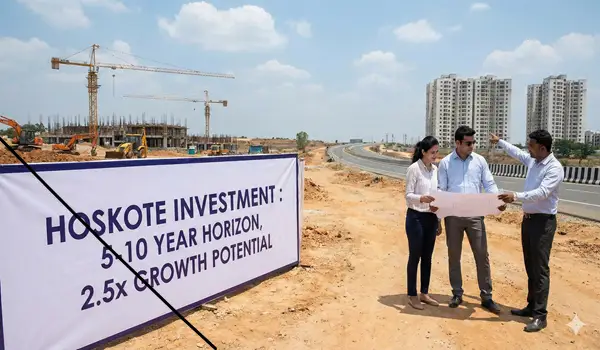
The real estate landscape of Bengaluru is undergoing a massive change. For long a year, the market only focused on all the major hubs like Whitefield and Sarjapur. However, as these areas reach saturation, a new star has emerged now. Hoskote, once a quiet town, is now the center of a high-value growth story.
Projects like Godrej Parkshire are more than just residential developments; they are strategic anchors for a new urban corridor. Early investors now view this region as the premier long-term opportunity in East Bengaluru. By the year 2026, Hoskote has transitioned from a peripheral suburb to a structured investment corridor. This roadmap explores why the next 5–10 years offer such aggressive capital growth.
Why Hoskote Is Entering Its High-Growth Investment Cycle (2026 Onwards)?
Every successful real estate micro-market follows a predictable four-stage pattern: land acquisition, infrastructure injection, end-user migration, and final price maturity. In 2026, Hoskote is firmly in the early acceleration stage.
The "Neo-Whitefield" Shift
East Bengaluru has seen incredible growth, but Whitefield is now a "mature" market. Prices there have peaked, and entry barriers are high. Consequently, smart capital is moving toward the "next Whitefield." Hoskote is the natural successor, offering:
- Price Advantage: A lower entry cost per square foot compared to the city core.
- Organized Urbanism: Unlike older city pockets, Hoskote benefits from the Master Plan 2031, ensuring planned growth.
- Institutional Credibility: The entry of branded developers like Godrej Properties has validated the micro-market.
When a brand enters a local market, the entire neighbourhood gains credibility. Branded developers bring high standards of construction and timely delivery. More importantly, they attract other businesses. Where a Godrej Parkshire project goes, retail chains, schools, and clinics follow. From 2026 to 2030, this cycle will create steady upward pressure on land values.
Infrastructure Catalysts That Could Drive 2.5x–3x Appreciation
In real estate, "connectivity is the currency of growth." You cannot achieve a 2.5x–3x appreciation without a transformation in mobility.
The STRR and Beyond
The Satellite Town Ring Road is the main game-changer with sections already operational in 2026, it connects Hoskote directly to the Kempegowda Airport and major industrial clusters. This bypasses city bottlenecks and slashes travel time.
Connectivity Milestones for 2030:
For a 2.5x–3x appreciation to become a reality by the year 2033, specific milestones must be met:
- The Bengaluru Business Corridor (PRR): This project is bridging the final gap between Hoskote and the rest of the IT corridor.
- Metro Expansion: BMRCL is conducting feasibility studies for a 16-km double-decker Metro corridor from KR Puram to Hoskote. This stage is crucial for managing long-term expectations while setting the foundation for massive future value.
- Industrial Hub Expansion: The proximity to the Narasapura Industrial Area ensures a constant flow of working professionals.
- Bangalore–Chennai Expressway: As the entry point for this 10-lane expressway, Hoskote is becoming a logistics and transit powerhouse.
If these infrastructure projects remain on track, the price "re-rating" of Hoskote is a logical outcome. However, investors must remember that this is a marathon. It takes 6–8 years for the full impact of a new highway or metro line to reflect in residential prices.
Demand Drivers: Industrial Expansion and Residential Spillover
A market built only on speculation will eventually crash. For Hoskote to thrive, it needs real demand. This demand is coming from two distinct sources: industrial jobs and residential spillover.
The Industrial Backbone
Hoskote is often called the "Gateway to the East." It is surrounded by massive industrial and logistics hubs. Proximity to the Narasapura Industrial Area and the new 300-acre Tavarekere Data Centre Park ensures a steady influx of high-earning professionals.
As these companies expand, thousands of employees will need housing. They will prefer to live in a modern complex like Godrej Parkshire rather than commuting 2 hours from the city.
The Spillover Effect
As core Bengaluru becomes more expensive, the "middle-class" buyer is pushed outward. This is called residential spillover. We saw it happen in Electronic City 15 years ago and in North Bengaluru 5 years ago. Now, it is Hoskote's turn. Investors are betting on the migration of the workforce. As long as Bengaluru remains a global tech hub, the demand for suburban housing will only grow.
Pricing Cycles: Early-Stage Entry vs. Mid-Cycle Buying
Timing defines the difference between a "good" investment and a "legacy" investment. Real estate moves in cycles, and understanding where Hoskote sits in 2026 is vital.
The Advantage of 2026
In 2026, Hoskote is in the "Early Expansion" phase. Prices are high enough to prove the market works, but low enough to offer significant "upside."
- Early-Stage (Current): You buy at a lower price per square foot. You face more "patience risk," but your potential for 3x returns is at its highest.
- Mid-Cycle (2029–2030): The infrastructure is visible. The risk is lower, but you will pay a premium to enter. Your returns might be 1.5x instead of 3x.
Phase Year Market Status Investor Action Potential Return
Early Expansion 2026–2027 High construction; Metro planning stages Accumulate Highest (2.5x+)
Value Surge 2028–2029 Major roads open; retail starts Hold Significant Jump.
| Phase | Year | Market Status | Investor Action | Potential Return |
|---|---|---|---|---|
| Early Expansion | 2026–2027 | High construction; Metro planning stages | Accumulate | Highest (2.5x+) |
| Value Surge | 2028–2029 | Major roads open; retail starts | Hold | Significant Jump |
| Maturity | 2030–2033 | End-users dominate; high demand | Exit/Sell | Profit Realization |
Risk Factors Investors Must Evaluate Before Committing
Every investment has risks. In Hoskote, you must balance your optimism with a cold look at the facts.
- Infrastructure Timelines: The biggest risk is delay. Because projects like the double-decker Metro are currently in the feasibility and planning phase, their completion dates are subject to change. You must have the financial "holding power" to wait.
- Supply vs. Demand: If too many developers launch 1,000-unit projects at once, the market becomes "oversupplied." This is why choosing a project like Godrej Parkshire is smart branded projects hold value better.
- Economic Factors: Real estate is sensitive to interest rates. High home loan rates slow down the exit strategy for investors.
- Regulatory Changes: Always check for RERA compliance. In emerging markets, "unapproved" layouts often pop up. Stick to RERA-registered developments.
Rental Yield vs. Pure Capital Appreciation Strategy
You must define your "Why." Are you looking for a monthly check, or a massive lump sum in 10 years?
The Reality of Rentals in Hoskote
Currently, Hoskote is not a high-rental-yield market. The rental market is still developing. However, as industrial hubs grow, "executive housing" demand will rise. Godrej Parkshire fits better into a long-term growth strategy.
The Appreciation Play
Hoskote is a Capital Appreciation play. The goal here is to buy while the area is still undervalued by the general public.
- Short-term (1–3 years): You might see 15–20% growth.
- Long-term (7–10 years): This is where the 200–300% growth happens as the area transforms into a city suburb.
Exit Strategy and Outlook Beyond 2030
An investment without an exit plan is just an expensive hobby. You need to know when to "ring the bell" and take your profits.
The 2030 Window
By 2030, Hoskote will look very different. The trees in Godrej Parkshire will be mature, the roads will be paved, and local shopping malls will be full. This is your primary exit window. Consider a Phased Exit:
- Sell 50% in 2030 to recover your initial capital and some profit.
- Hold the remaining 50% until 2033 to capture the "peak maturity" pricing.
Beyond 2030
By the mid-2030s, Hoskote will be an established residential zone. Price growth will stabilize to match inflation (6 - 8% per year). The "wealth-building" phase will be over, and it will become a "wealth-preservation" zone.
Conclusion
Hoskote presents a structured, logical, and highly potent investment story for the next decade. The roadmap from 2026 to 2030 is paved with infrastructure upgrades and industrial growth. While risks exist, a disciplined approach focusing on branded developments and long-term holding minimizes the downside.
The potential for 2.5x–3x appreciation is real for those who act before the secret is out. It is always said to invest wisely, enter early, hold patiently and exit strategically. Godrej Parkshire Bangalore stands as a testament to this growth potential.
